the science behind extended-release tablets, protective coatings, and safer medication administration
the pharmacy edit | medication science
the question behind the pill crusher
if a tablet is difficult to swallow, crushing it into applesauce or water might seem like an easy solution. but medications are not always designed to work the same way once they are broken apart.
a tablet or capsule can contain a carefully engineered system that controls when the drug is released, where it dissolves, and how the body absorbs it. altering that system can sometimes change both effectiveness and safety.
this is why pharmacists ask a specific question before recommending a pill crusher: is this exact product safe to crush, split, disperse, or open?
the answer depends on the formulation, not just the drug name.
1. extended-release medications: too much, too quickly
extended-release formulations are designed to release medication gradually over time.
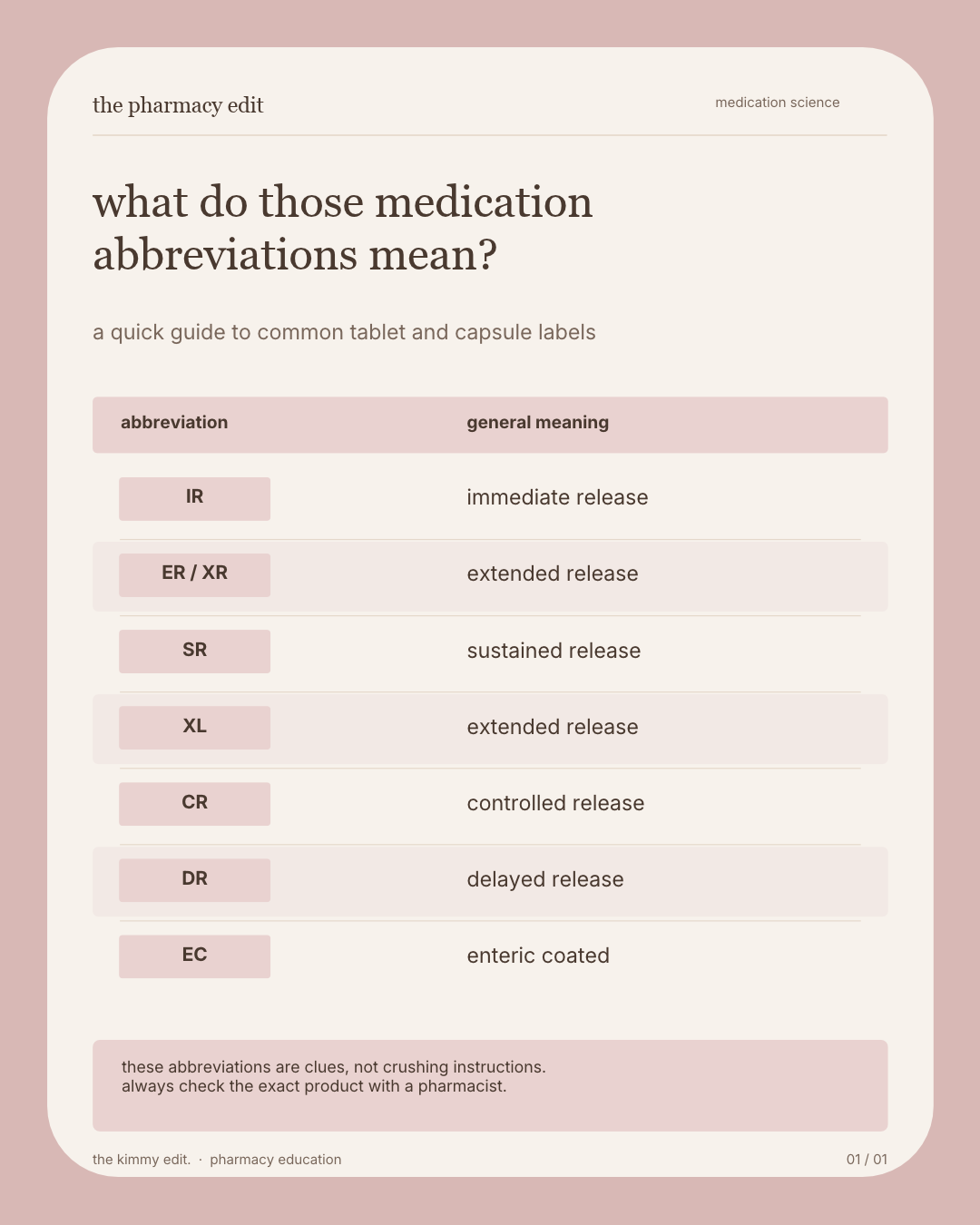
you might recognize abbreviations such as ER, XR, XL, SR, or CR on prescription labels.
these formulations may use specialized coatings, matrices, or other delivery systems to control how quickly a medication enters the body.
crushing certain extended-release tablets can disrupt these systems and cause dose dumping, where medication is released much faster than intended.
this can lead to higher peak drug concentrations, increased adverse effects, and a shorter duration of therapeutic action.
a real medication example: Wellbutrin XL
Wellbutrin XL contains bupropion, an antidepressant formulated for extended release.
according to its FDA-approved prescribing information, the tablets must be swallowed whole.
crushing, cutting, or chewing Wellbutrin XL can cause the medication to be released too quickly, increasing the risk of adverse effects, including seizures.
this demonstrates why the dosage form is just as important as the active ingredient.
2. delayed-release and enteric coatings: location matters
some medications are designed to pass through the acidic environment of the stomach before releasing their active ingredients.
these formulations may be labeled as delayed-release (DR) or enteric-coated (EC).
their protective coatings can help prevent acid-sensitive medications from degrading or delay drug release until later in the gastrointestinal tract.
crushing these medications can destroy the protective barrier.
depending on the medication, this may alter absorption, reduce effectiveness, or increase irritation.
a real medication example: Prilosec
Prilosec contains omeprazole, a proton pump inhibitor used to reduce stomach acid production.
certain delayed-release omeprazole capsules contain specially coated pellets that protect the medication from stomach acid.
some formulations may be opened and the intact pellets sprinkled onto applesauce according to the manufacturer's instructions.
however, the pellets should not be crushed or chewed.
opening an approved capsule is not the same as crushing its contents.
3. route of absorption: not every tablet is meant to be swallowed
not all medications are designed for absorption through the gastrointestinal tract.
some medications are administered through the oral mucosa.
sublingual medications dissolve under the tongue, while buccal medications are placed against the inside of the cheek.
these routes can allow certain medications to enter the bloodstream without undergoing the same degree of first-pass metabolism as swallowed medications.
crushing and swallowing these products instead of following their intended administration instructions may change their absorption and therapeutic effects.
4. exposure risk: protecting the person preparing the dose
another important consideration is the potential exposure created when medications are crushed.
crushing tablets can produce airborne powder or leave medication residue on equipment and surrounding surfaces.
this is particularly concerning for certain hazardous medications, including some anticancer drugs, immunosuppressants, hormonal medications, and medications associated with reproductive risks.
exposure through inhalation or skin contact can potentially harm caregivers and healthcare professionals.
some medications require specialized handling precautions, while others should not be manipulated at all.
5. even capsules are not all alike
it's easy to assume that capsules can simply be opened and mixed into food.
however, some capsules contain powders, while others contain specially formulated pellets or granules.
the capsule shell itself may also play an important role in how the medication is absorbed.
a real medication example: Pradaxa
Pradaxa contains dabigatran etexilate, an anticoagulant used for certain conditions involving blood clot prevention and treatment.
according to FDA prescribing information, taking dabigatran pellets without the capsule shell increases oral bioavailability by approximately 75% compared with taking the intact capsule.
this means opening the capsule can substantially increase medication exposure.
because anticoagulants carry important bleeding risks, following the administration instructions is especially important.
what do those medication abbreviations mean?
an immediate-release medication is not automatically safe to crush. similarly, certain modified-release capsules have approved administration methods that allow their contents to be sprinkled onto food without damaging the individual pellets.
the exact product instructions always matter.
what if you have trouble swallowing medications?
difficulty swallowing tablets is common, and there may be safer alternatives than crushing them.
depending on the medication, a pharmacist may recommend discussing:
a commercially available liquid formulation
an orally disintegrating or dispersible tablet
an approved sprinkle formulation
a different tablet size or formulation
an alternative medication or route of administration
some immediate-release tablets may be crushed or dispersed when appropriate, but this should always be verified before altering the medication.
for patients receiving medications through feeding tubes, additional considerations include tube compatibility, medication absorption, and interactions with enteral nutrition.
if swallowing difficulty also affects food or liquids, medical evaluation may be necessary.
a pharmacy pearl: splitting and crushing are not the same
one misconception is that a tablet with a score line can automatically be crushed.
a score line may indicate that a tablet can be divided into smaller doses, but it does not necessarily mean the medication can be crushed into powder.
likewise, permission to open a capsule does not automatically mean its contents can be chewed or crushed.
the safest approach is to check the exact medication, strength, manufacturer, dosage form, and administration instructions before making any changes.
the takeaway
a medication's formulation plays an important role in determining how it is released, absorbed, and used by the body.
crushing a tablet might seem like a small adjustment, but for certain medications, it can significantly change their safety and effectiveness.
from extended-release systems to enteric coatings and specialized capsules, pharmaceutical formulation is an essential part of medication therapy.
and this is one of the many reasons pharmacists play such an important role in medication safety.
before crushing, splitting, chewing, or opening a medication, ask your pharmacist whether it's appropriate for your specific product.
references
NHS Specialist Pharmacy Service. checking if tablets can be crushed or capsules opened (2025).
NHS Specialist Pharmacy Service. choosing medicines formulations in swallowing difficulties (2025).
DailyMed. Prilosec delayed-release capsule administration instructions.
NHS Specialist Pharmacy Service. advising how to crush or disperse tablets and open capsules (2024).
educational disclaimer: this article was developed for general medication education and does not constitute personalized medical advice. medication formulations and administration instructions vary. consult a pharmacist or prescribing healthcare professional before altering how a medication is taken.