
wellness, explained | gut health & microbiome science
gut health has become one of the most discussed topics in the wellness industry. from probiotic supplements and fermented foods to prebiotic fibers and emerging postbiotic formulations, there seems to be a new product promising to support the gut microbiome every day.
but what do these terms actually mean?
although prebiotics, probiotics, and postbiotics are closely related to the microbiome, they are not interchangeable. each represents a different approach to interacting with microorganisms in the body.
understanding these differences can help us separate scientifically supported benefits from wellness marketing claims.
let's explore what the research says about each category, how they work, and whether supplementation is necessary.
first, what is the gut microbiome?
the gut microbiome refers to the collective genetic material of microorganisms living in the gastrointestinal tract, while the gut microbiota refers to the microorganisms themselves.
these microbial communities include bacteria, archaea, fungi, viruses, and other microorganisms.
the gut microbiota participates in several physiological processes, including:
digestion and fermentation: helping break down certain dietary components that human digestive enzymes cannot fully digest.
production of microbial metabolites: generating compounds such as short-chain fatty acids through fermentation.
immune system regulation: interacting with immune cells and contributing to normal immune development and function.
intestinal barrier function: participating in processes that help maintain the protective lining of the gastrointestinal tract.
metabolic signaling: influencing pathways involved in nutrient metabolism and communication between the gut and other organs.
however, microbiome research is still evolving.
there is no single universally ideal microbiome composition, and greater microbial diversity does not automatically indicate better health in every situation.
the goal should not be to maximize every bacterial species, but rather to support normal microbial function through evidence-based dietary and clinical approaches.
what are prebiotics?
prebiotics are substances that are selectively utilized by microorganisms living in or on the body and produce a demonstrated health benefit.
in simpler terms, prebiotics provide specific substrates that beneficial microorganisms can use.
many well-studied prebiotics are dietary carbohydrates that resist digestion in the upper gastrointestinal tract and become available for microbial fermentation.
how do prebiotics work?
when certain gut microorganisms ferment prebiotic substrates, they can produce metabolites such as short-chain fatty acids.
these include:
acetate
propionate
butyrate
short-chain fatty acids participate in intestinal and metabolic processes.
for example, butyrate serves as an important energy source for colonocytes, the cells lining the colon, and contributes to intestinal barrier function.
however, not every fermentable fiber qualifies as a prebiotic.
to meet the scientific definition, a substance must be selectively utilized by host microorganisms and demonstrate a health benefit.
examples of prebiotic ingredients
well-studied prebiotic ingredients include:
inulin
fructooligosaccharides (fos)
galactooligosaccharides (gos)
these compounds are found naturally in certain foods or added to supplements and food products.
foods that contain prebiotic fibers
examples include:
garlic
onions
leeks
asparagus
chicory root
bananas
certain whole grains
the quantity and type of prebiotic compounds vary depending on the food and its preparation.
the takeaway: prebiotics support specific microorganisms by providing substrates they can utilize. however, not every fiber or plant food has been demonstrated to meet the formal definition of a prebiotic.
what are probiotics?
probiotics are live microorganisms that provide a demonstrated health benefit when administered in adequate amounts.
unlike prebiotics, which are substrates, probiotics are the microorganisms themselves.
certain probiotic strains have been investigated for gastrointestinal conditions, antibiotic-associated diarrhea, and other clinical applications.
however, probiotic benefits are not universal.
why probiotic strains matter
one of the most important concepts in probiotic science is strain specificity.
two microorganisms belonging to the same species may have different clinical effects.
for example, the designation lacticaseibacillus rhamnosus gg identifies a particular probiotic strain, rather than all bacteria belonging to the species.
this distinction matters because clinical findings from one strain cannot automatically be applied to another.
a supplement containing several bacterial species is not necessarily more effective than a product containing one well-studied strain.
what does the clinical evidence say?
research suggests that certain probiotic formulations may reduce the risk of antibiotic-associated diarrhea in some populations.
however, the magnitude of benefit depends on factors such as:
the probiotic strain or combination
the administered dose
the patient's age and underlying health
the antibiotic regimen
the specific clinical outcome being studied
evidence is inconsistent for many other advertised uses, including general digestive wellness in otherwise healthy adults.
probiotics should therefore be evaluated according to the specific condition and product being considered.
are fermented foods considered probiotics?
not necessarily.
foods such as yogurt, kefir, kimchi, and sauerkraut may contain live microorganisms.
however, the presence of live microorganisms alone does not establish that a food meets the scientific definition of a probiotic.
the microorganisms must be appropriately characterized and shown to provide a health benefit at the amount consumed.
the takeaway: probiotics are live microorganisms with demonstrated benefits, but their effectiveness depends on the specific strain, dose, and clinical application.
what are postbiotics?
postbiotics are a newer and frequently misunderstood category in microbiome science.
according to the international scientific association for probiotics and prebiotics (isapp), a postbiotic is a preparation containing inanimate microorganisms and/or their components that provides a demonstrated health benefit.
in other words, postbiotics contain microorganisms that are no longer alive, or their cellular components, in a preparation shown to benefit health.
this is different from probiotics, which must contain living microorganisms.
how are postbiotics produced?
postbiotic preparations generally begin with microorganisms that are intentionally inactivated through controlled processing.
methods may include:
heat treatment
ultraviolet exposure
other validated inactivation processes
the resulting preparation can contain microbial cells, cellular fragments, and associated compounds.
importantly, these preparations must demonstrate a health benefit to qualify as postbiotics.
are short-chain fatty acids postbiotics?
this is an important scientific distinction.
short-chain fatty acids such as butyrate are microbial metabolites, but purified butyrate alone is not classified as a postbiotic under the isapp consensus definition.
similarly, not every substance produced during fermentation is a postbiotic.
the preparation must contain inanimate microorganisms and/or their components, with a demonstrated health benefit.
what are the potential benefits?
researchers are investigating postbiotic preparations for applications involving:
gastrointestinal function
immune responses
intestinal barrier function
selected pediatric and adult health outcomes
however, evidence varies substantially between preparations.
postbiotics should not be assumed to provide the same benefits as live probiotics, and findings from one formulation cannot automatically be generalized to another.
the takeaway: postbiotics are scientifically defined preparations of inanimate microorganisms and/or their components with demonstrated benefits. the field is promising, but evidence remains product- and indication-specific.
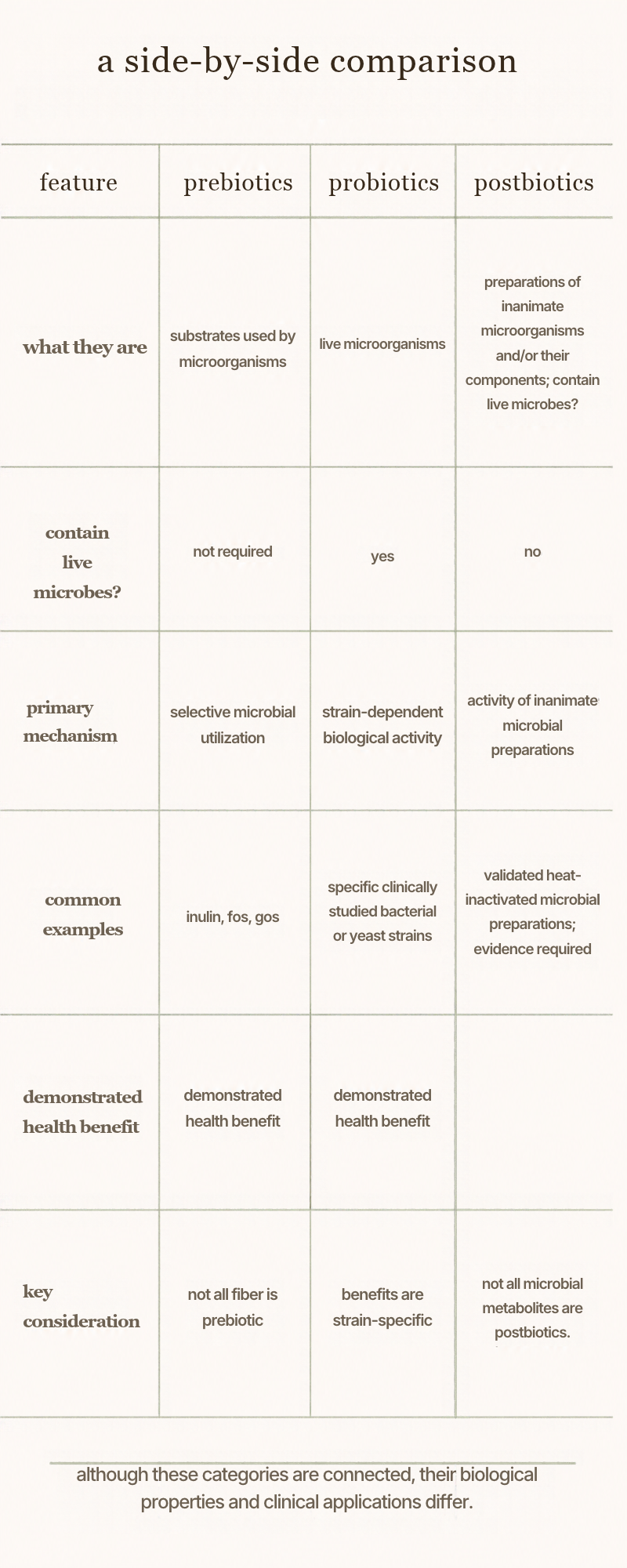
prebiotics vs. probiotics vs. postbiotics: a side-by-side comparison
how do these three categories work together?
the relationship between prebiotics, probiotics, and postbiotics is sometimes presented as a simple sequence.
however, the science is more nuanced.
prebiotics may be selectively utilized by certain microorganisms already living in the gut.
probiotics introduce specific live microorganisms that have demonstrated benefits under defined conditions.
postbiotics provide preparations of inanimate microorganisms or their components that can exert biological effects without requiring the microorganisms to remain alive.
these approaches can overlap in their biological targets, but one does not automatically lead to the other.
what about synbiotics?
synbiotics are preparations combining live microorganisms with substrates selectively utilized by microorganisms, with a demonstrated health benefit.
some synbiotic products combine established probiotics and prebiotics, while others are designed so that the substrate specifically supports the co-administered microorganism.
simply mixing a probiotic supplement with a fiber supplement does not necessarily establish that the combination meets the scientific definition of a synbiotic.
can you support your gut microbiome through diet?
before purchasing a microbiome supplement, it is worth considering the role of everyday nutrition.
dietary patterns rich in diverse plant foods can provide fibers and other compounds that interact with the gut microbiota.
foods that may contribute to a microbiome-supportive dietary pattern include:
legumes: beans, lentils, and chickpeas provide dietary fiber.
whole grains: oats, barley, and whole wheat provide various fermentable and nonfermentable fibers.
vegetables: asparagus, onions, garlic, and leafy greens contribute different plant compounds.
fruits: bananas, berries, and apples provide fiber and other nutrients.
nuts and seeds: almonds, walnuts, flaxseeds, and chia seeds contribute fiber and healthy fats.
fermented foods: yogurt, kefir, kimchi, and sauerkraut may provide live microorganisms, depending on preparation and processing.
not every food listed contains a scientifically established prebiotic, probiotic, or postbiotic.
however, these foods can contribute to a balanced, nutrient-dense dietary pattern.
why dietary diversity matters
different microorganisms can utilize different dietary substrates.
consuming a variety of plant foods helps provide a broader range of nutrients and fermentable compounds.
for many otherwise healthy individuals, prioritizing a balanced diet is a reasonable starting point before considering specialized microbiome supplements.
a healthy gut begins with consistent dietary habits, not necessarily a supplement routine.
are microbiome supplements safe for everyone?
although many probiotic and prebiotic products are well tolerated by healthy individuals, they are not appropriate for every patient.
potential gastrointestinal effects
prebiotic fibers can cause:
bloating
gas
abdominal discomfort
changes in bowel habits
these effects may be more noticeable when intake increases rapidly.
probiotic safety considerations
probiotics contain live microorganisms.
although serious complications are uncommon in otherwise healthy individuals, infections associated with probiotic organisms have been reported in vulnerable populations.
additional caution is warranted for individuals who are severely immunocompromised, critically ill, or have certain significant medical conditions.
postbiotic safety considerations
because postbiotics contain inanimate microorganisms, they do not require microbial viability.
however, this does not mean every postbiotic product is automatically safe or effective.
safety depends on the specific preparation, dose, manufacturing process, and intended population.
should you take prebiotics, probiotics, or postbiotics?
the answer depends on your individual health needs.
if your goal is to support general digestive health, evaluating dietary fiber intake and overall nutrition is a practical starting point.
if you are considering probiotics for a particular gastrointestinal condition, the decision should be based on clinical evidence for the specific strain and indication.
if you are interested in postbiotics, it is important to recognize that this is an evolving research area and that product-specific evidence matters.
more supplements do not necessarily translate to better gut health.
the bottom line: understanding the science behind gut health
prebiotics, probiotics, and postbiotics represent three scientifically distinct approaches to interacting with microorganisms in the body.
prebiotics provide substrates that selected microorganisms can utilize.
probiotics are live microorganisms that have demonstrated health benefits when administered in adequate amounts.
postbiotics are preparations of inanimate microorganisms and/or their components that have demonstrated health benefits.
although all three are relevant to microbiome research, their clinical applications, mechanisms, and evidence are not interchangeable.
the most important consideration is not which category is trending, but whether a specific intervention has meaningful evidence for its intended use.
because understanding the science behind wellness is just as important as the products we choose to use.
references
hill c, et al. (2014). expert consensus document: the international scientific association for probiotics and prebiotics consensus statement on the scope and appropriate use of the term probiotic. nature reviews gastroenterology & hepatology. https://doi.org/10.1038/nrgastro.2014.66
gibson gr, et al. (2017). expert consensus document: the international scientific association for probiotics and prebiotics consensus statement on the definition and scope of prebiotics. nature reviews gastroenterology & hepatology. https://doi.org/10.1038/nrgastro.2017.75
salminen s, et al. (2021). the international scientific association of probiotics and prebiotics (isapp) consensus statement on the definition and scope of postbiotics. nature reviews gastroenterology & hepatology. https://doi.org/10.1038/s41575-021-00440-6
swanson ks, et al. (2020). the international scientific association for probiotics and prebiotics (isapp) consensus statement on the definition and scope of synbiotics. nature reviews gastroenterology & hepatology. https://doi.org/10.1038/s41575-020-0344-2
national center for complementary and integrative health. probiotics: use and safety. https://www.nccih.nih.gov/health/probiotics-usefulness-and-safety
international scientific association for probiotics and prebiotics. a roundup of the isapp consensus definitions. https://isappscience.org/a-roundup-of-the-isapp-consensus-definitions-probiotics-prebiotics-synbiotics-postbiotics-and-fermented-foods/
wellness, explained is an independent educational series created by a pharmacy student with an interest in integrative health and evidence-based wellness. this article is intended for general informational purposes and does not constitute individualized medical advice, diagnosis, or treatment. supplements may interact with medications or be inappropriate for certain medical conditions. consult a qualified healthcare professional before starting or changing a supplement regimen.